
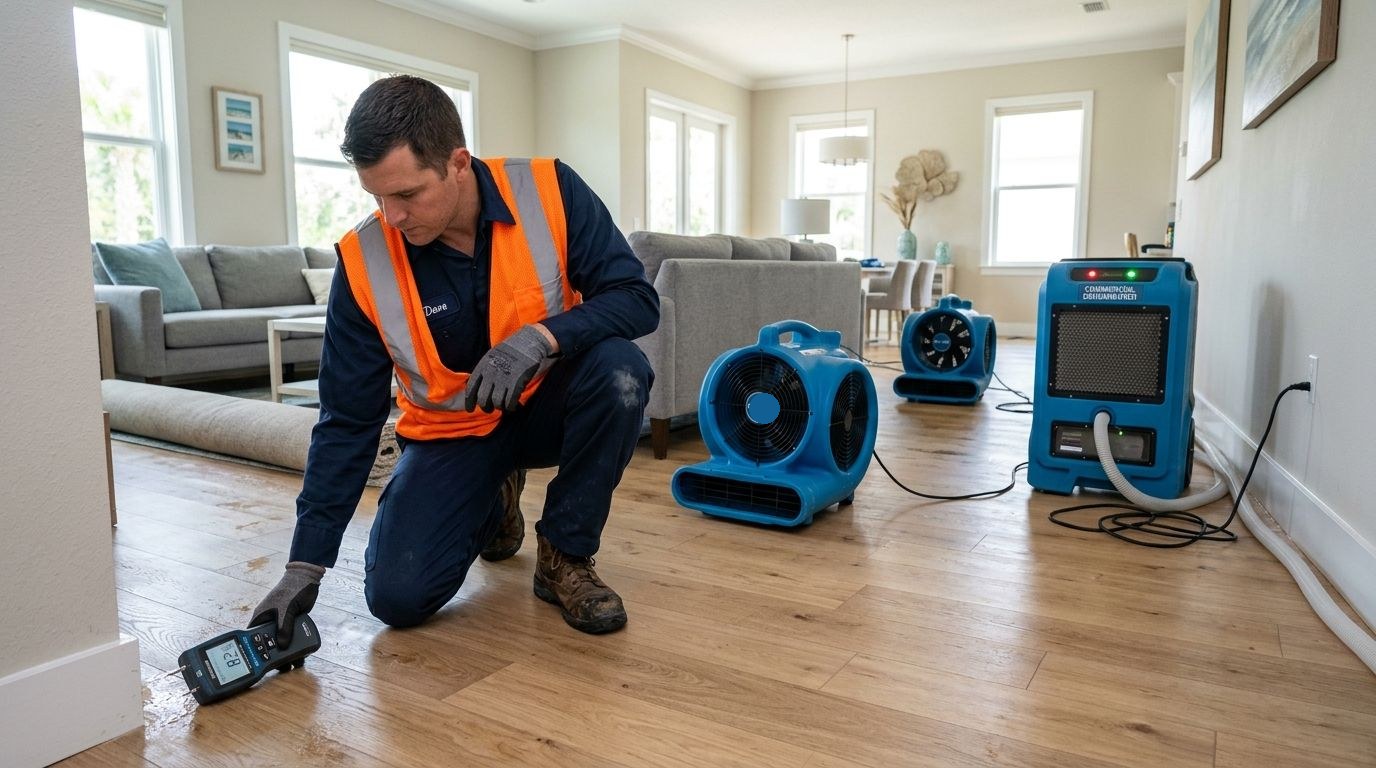
Professional Water Extraction When Your Property Has Water Damage
Fast, focused water removal, moisture assessment, and structural drying support for homes and businesses throughout Spring Hill and surrounding Hernando County communities.
Active Leak or Standing Water?
Water migrates through flooring and baseboards within hours. Share your incident details for prompt dispatch coordination.
What Caused the Water Problem?
Select the incident that best describes what happened. Every water source carries distinct migration patterns, contamination categories, and drying requirements.
Water Damage Services Built Around the Problem You Have
From emergency bulk liquid extraction to scientific structural drying: dedicated services engineered for actual Florida water-loss scenarios.
Water Extraction & Emergency Water Removal
Rapid bulk liquid removal from tile, concrete, carpet, and subfloors using commercial extraction wands and submersible pumps.
- ✓ Immediate standing liquid recovery
- ✓ Weighted carpet & cushion extraction
- ✓ Prevents lateral subfloor migration
Water Damage Restoration
Comprehensive incident coordination from source containment through extraction, moisture mapping, and complete structural stabilization.
- ✓ Full loss documentation for records
- ✓ Contained multi-room drying plans
- ✓ Secondary damage mitigation
Moisture Detection & Mapping
Investigate behind baseboards, beneath floating floors, and inside wall cavities using thermal cameras and calibrated pin/pinless meters.
- ✓ Non-invasive infrared boundary scans
- ✓ Deep-cavity probe moisture readings
- ✓ Identifies concealed moisture pockets
Structural Drying & Dehumidification
Evaporate moisture bound in framing, drywall, and subfloors with commercial high-velocity air movers and low-grain refrigerant dehumidifiers.
- ✓ Engineered psychrometric airflow
- ✓ Lowers indoor grains per pound (GPP)
- ✓ Daily moisture tracking to dry standards
Flood Cleanup & Water Recovery
Mitigate outdoor runoff, flash storm ponding, and slab intrusion with specialized extraction, sediment removal, and antimicrobial washes.
- ✓ Category 2 / 3 water handling protocols
- ✓ Saturated baseboard & drywall relief cuts
- ✓ Structural framing sanitization
Sewage Backup Cleanup & Sanitization
Strictly controlled containment and extraction for blackwater toilet backups, main drain blockages, and hazardous indoor wastewater spills.
- ✓ Biohazard containment zoning
- ✓ Removal of porous contaminated pad/trim
- ✓ EPA-registered antimicrobial treatment
Storm Water Damage Cleanup
Urgent response after tropical depressions, hurricanes, and severe thunderstorm squalls drive rain through roofing and exterior window penetrations.
- ✓ Roof & soffit intrusion mitigation
- ✓ Attic insulation & ceiling drainage
- ✓ High-volume coastal water stabilization
Commercial Water Damage Mitigation
Focused business water removal and low-noise structural drying planned around operational schedules, retail areas, and tenant occupancy.
- ✓ Minimizes business disruption
- ✓ Large-format slab & corridor extraction
- ✓ Documented commercial drying logs
Visible Water Isn't Always the Whole Problem
Indoor water follows the path of least resistance. Surface extraction removes accessible liquid, but building materials absorb, wick, and trap moisture deep within structural cavities.

How Moisture Migrates Beyond the Puddle
-
01
Standing Water & Flooring Seams
Water settles on hard surfaces (tile, LVP, laminate, hardwood) and penetrates perimeter expansion joints, grout lines, and tongue-and-groove locking seams within minutes.
-
02
Cushion, Underlayment & Subfloor
Under floating floors and carpets, vapor barriers and foam padding hold moisture against concrete slabs or wooden subflooring, preventing natural air evaporation.
-
03
Baseboards & Bottom Drywall Edge
Gypsum drywall core acts like a sponge. Through capillary wicking action, water climbs vertically behind painted baseboards up to 12 to 24 inches high into wall panels.
-
04
Stud Cavities, Insulation & Toe-Kicks
Moisture travels past the bottom plate into enclosed wall cavities and dark cabinet toe-kicks, creating humidity microclimates that require commercial dehumidification.
The 3-Stage Scientific Solution
Water Damage Response Guide
Identify practical next steps and safety considerations based on your incident. This guide provides objective informational guidance and can pre-fill your service request.
Recommended Action Sequence
Immediate action protocol based on your reported incident:
- Isolate Source: Confirm or shut off incoming water flow where safely accessible.
- Physical Extraction: Remove accessible standing water before it saturates subfloors.
- Moisture Mapping: Map moisture migration beyond the visible wet boundary.
- Controlled Drying: Deploy commercial dehumidifiers and high-velocity air movers.
Standing water and multiple materials are involved. Visible water can extend beyond the obvious wet area through floor edges, baseboards, and wall assemblies. Bulk water removal should be followed by moisture assessment to determine how far moisture has travelled.
Safety Notice: This browser guide provides general orientation. Professional moisture meters and thermal imaging are necessary to verify whether building assemblies are dry.
What Happens After You Request Water-Damage Service
A disciplined, science-grounded response sequence designed to halt water migration, remove standing liquid, and thoroughly dry structural components.
Understand the Situation
Review the reported water source, verify whether supply is stopped, identify affected rooms, and screen for immediate electrical hazards or structural saturation.
Assess Moisture & Trace Paths
Inspect visible and concealed materials using non-penetrating moisture meters and penetrating probes to map exactly how far moisture has travelled.
Extract Standing Water
Deploy weighted extraction wands and high-volume commercial pumps to physically remove pooled water from hard floors, carpets, and accessible structural surfaces.
Dry Affected Materials
Install centrifugal air movers and low-grain refrigerant (LGR) dehumidifiers engineered to evaporate bound moisture and lower relative ambient humidity.
Monitor & Adjust Equipment
Track psychrometric readings daily. A surface that feels dry to the touch can still harbor high internal moisture that requires continued dehumidification.
Verify Dry Standards
Confirm that structural components meet dry baseline standards compared against unaffected materials, documenting readings for records and insurance.
Note: Every water intrusion incident presents unique structural configurations. Protocols are adapted to match property materials and contamination category.
Water Doesn't Always Stop Where the Stain Stops
Professional moisture detection evaluates both surface finishes and hidden structural assemblies to ensure no pocket of moisture is overlooked.
Tile & Concrete Slabs
Glazed tiles resist water on top, but water easily channels through grout lines, perimeter expansion gaps, and wicks under nearby door thresholds.
Key checks: Grout joints, slab contact, perimeter framingWalls & Baseboards
Baseboards hide the drywall gap where moisture enters. Capillary action draws water upward through drywall gypsum and inside internal wall cavities.
Key checks: Baseboard removal, bottom plate, cavity humidityCabinets & Vanities
Toe-kicks create enclosed crawl spaces beneath kitchen and bathroom cabinets. Water can pool out of sight while the front of the vanity appears completely dry.
Key checks: Toe-kick sub-voids, rear particleboard panelsCeilings & Insulation
Roof and upper-level plumbing leaks saturate attic insulation, which holds water against drywall until the ceiling sags, blisters, or collapses under weight.
Key checks: Joist contact, blown insulation, structural sagCarpet & Cushion
Carpet face fibers dry much faster than the dense foam cushion underneath. Wet padding must be thoroughly extracted and inspected to save subflooring.
Key checks: Delamination, pad saturation, tack stripsLVP & Laminate Flooring
Waterproof luxury vinyl planks trap liquid below their locking joints. Trapped water against a concrete slab cannot evaporate without targeted intervention.
Key checks: Locking seams, underlayment moisture trappingHardwood & Trim
Solid wood absorbs moisture slowly but retains it tenaciously. As moisture content rises, wood fibers expand, causing crowning, cupping, or buckling.
Key checks: Moisture content % compared to dry standardAdjacent Rooms & Closets
Water follows subfloor grade and wall plates into adjacent rooms, hallways, and closets where owners do not initially suspect water penetration.
Key checks: Cross-room moisture boundary mappingServing Spring Hill Properties: Residential & Commercial
Whether protecting your family home or stabilizing a business facility, our extraction and structural drying protocols scale to match the footprint of the loss.
Residential Water Extraction
Immediate water removal and drying support tailored to single-family homes, townhomes, condominiums, and rental living spaces across Spring Hill.
- Living Areas & Bedrooms: Carpet extraction, furniture elevation, baseboard removal, and pad moisture recovery.
- Kitchens & Bathrooms: Cabinet toe-kick drying, dishwasher supply line leaks, and toilet overflow sanitization.
- Attics & Utility Closets: HVAC condensate pan drainage issues, water heater failures, and ceiling drywall mitigation.
- Garages & Slabs: Heavy rainfall ponding, exterior seepage, and stored item protection.
Commercial Water Mitigation
Rapid bulk liquid removal and controlled structural drying engineered to minimize operational downtime for local business facilities.
- Professional Offices & Clinics: Low-profile drying setups protecting document storage, computer hardware, and employee spaces.
- Retail & Storefronts: High-volume carpet extraction, tile drying, and inventory containment.
- Managed Multi-Unit Properties: Multi-room coordination, tenant safety procedures, and objective moisture tracking.
- Warehouses & Commercial Slabs: Large-square-footage standing water extraction and high-capacity dehumidification.
Why Florida Water Damage Requires a Localized Strategy
In Spring Hill's subtropical climate, standard drying approaches used in northern regions do not work. High outdoor humidity prevents indoor evaporation and demands industrial dehumidification equipment.
As UF/IFAS research notes, residential AC units in Florida run continuously through humid months. Algae and sediment frequently choke 3/4-inch PVC condensate lines, causing attic air-handlers to overflow through ceilings.
Hernando County weather delivers intense tropical downpours and wind-driven rain that exploit roof flashing, soffits, and window weep holes, driving moisture deep into exterior wall assemblies.
Most Spring Hill homes are built on monolithic concrete slabs. When water migrates beneath luxury vinyl plank or tile underlayment, it cannot breathe without active commercial air movement.
Official Hernando County Floodplain Verification
Flood risk varies dramatically between coastal areas like Hernando Beach and inland Spring Hill subdivisions. Never guess your property flood zone from a ZIP code alone.
Environmental Factors Influencing Structural Drying
- Subtropical Humidity & Vapor Pressure: High outdoor relative humidity retards natural evaporation, requiring closed-environment LGR dehumidification.
- HVAC Condensate Volume: Florida heat causes central AC systems to generate 5–20 gallons of water daily, making drain line clogs a leading indoor loss source.
- Convective Storm & Wind-Driven Rain: Intense tropical rain squalls force water through tile penetrations, soffits, and sliding door tracks.
- Karst Geology & Drainage Realities: Inland elevation contrasts with coastal zones like Hernando Beach, creating localized drainage patterns.
Check Service Availability for Your Location
Enter your 5-digit ZIP code to check response availability. Service dispatch for specific Hernando County neighborhoods is coordinated upon service request review.
Serving Spring Hill & Verified Nearby Communities
Dedicated water extraction, structural drying, and moisture investigation teams serving residential neighborhoods and commercial properties across Hernando County.
Spring Hill, FL
Serving ZIP codes: 34606, 34608, 34609, 34610
Immediate water removal and structural drying for high-density subdivisions, concrete slab homes, plumbing failures, and AC condensate leaks across central Spring Hill.
- ✓ Standing water recovery on tile & carpet
- ✓ Attic AC air-handler overflow mitigation
- ✓ Commercial facility emergency drying
Brooksville, FL
Serving ZIP codes: 34601, 34602, 34604
Extraction and drying for historic properties, newer residential developments, well-system supply pipe failures, and rural residential acreage throughout Brooksville.
- ✓ Well pump & supply-line pipe breaks
- ✓ Older crawl space & slab moisture mapping
- ✓ Agricultural & commercial facility water removal
Weeki Wachee, FL
Serving ZIP codes: 34607, 34613, 34614
Specialized drying along the Weeki Wachee river basin and coastal transition areas vulnerable to rising water tables, heavy seasonal storms, and roof penetration.
- ✓ High water table ground seepage recovery
- ✓ Storm-driven rain and window intrusion
- ✓ Rapid dehumidification in high-humidity zones
Hernando Beach, FL
Serving ZIP code: 34607
Water extraction and structural drying for waterfront stilt homes, ground-floor enclosures, canal-side properties, and storm floodwater mitigation.
- ✓ Canal & coastal floodwater cleanup protocols
- ✓ Ground-level storage & garage slab extraction
- ✓ Salt-air compatible commercial drying equipment
Frequently Asked Questions
Clear, factual guidance on water extraction, drying timelines, and property safety.
What is the difference between water extraction and structural drying?
Water extraction physically removes liquid standing water that can be vacuumed or pumped out using commercial extraction wands. Structural drying begins after bulk water is removed; it uses commercial air movers and LGR dehumidifiers to pull trapped moisture out of drywall, subfloors, and framing materials until dry baselines are reached.
Can a room look completely dry on the surface but still harbor moisture?
Yes. In Florida's humid climate, water readily seeps under floating luxury vinyl planks (LVP), carpet padding, and behind baseboards into wall cavities. While the surface feels dry to the hand, trapped water continues degrading materials and fostering microbial growth unless verified with calibrated moisture meters.
How quickly should water-damaged materials be dried?
According to EPA guidance, wet materials should be thoroughly dried within 24 to 48 hours to prevent mold germination. Prompt extraction and establishing commercial dehumidification immediately following a water loss are critical to preserving drywall, framing, and flooring.
Should I run ordinary household fans after an indoor water leak?
Not automatically. If the water comes from a contaminated source such as a sewage backup, outdoor storm flooding, or has remained stagnant, ordinary household fans can aerosolize bacteria and mold spores throughout unaffected living areas. Wait until water categories are verified and contained.
Does water extraction include fixing the underlying plumbing or roof leak?
Water extraction addresses water already inside your building materials to halt structural deterioration. Fixing an active burst pipe requires a licensed plumber, while roofing damage requires a licensed roofing contractor. Our team focuses on water removal, moisture mapping, and structural drying.
Don't Wait Until a Small Water Problem Becomes a Bigger One
Water migrates into dry subflooring and drywall cavities every hour it sits unmitigated. Call dispatch or request service online so our local team can assess your property.
-
1
Source & Safety Check Verify electrical hazards and water supply shutoff
-
2
Bulk Water Extraction Remove free standing liquid from floors and carpet
-
3
Moisture Boundary Mapping Detect hidden moisture in baseboards and framing
-
4
Dehumidification Setup Commercial drying equipment installed immediately
Request Water Extraction Service
Provide your contact details and property location below. You do not need to diagnose the entire loss before asking for help—our technicians evaluate the source, migration, and wet materials on-site.